
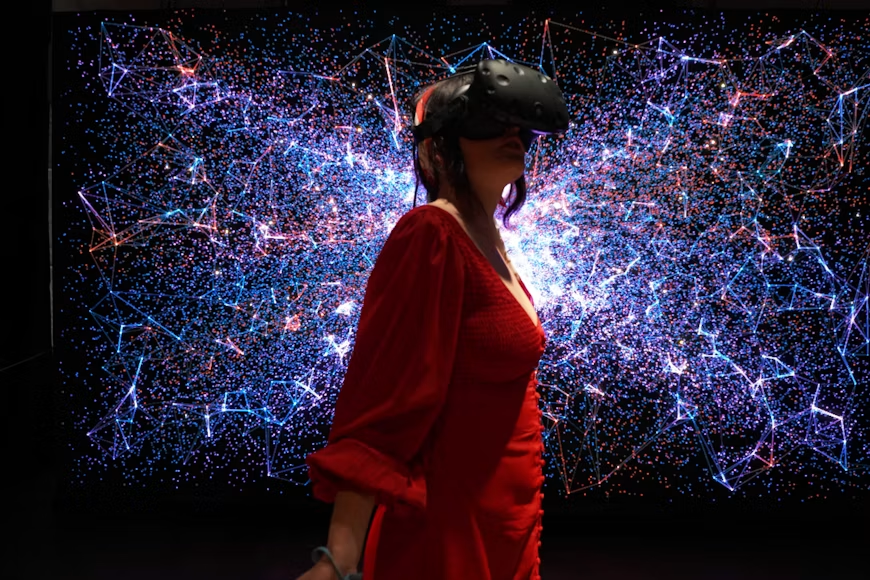
Virtual reality is changing how people connect online.
Screens were flat for years. User interactions were one-dimensional. Then came VR. Virtual reality technology is one of the fastest-growing digital transformations of the decade, impacting nearly every industry imaginable. Gaming, healthcare, entertainment – VR is changing the way we use the internet.
Here’s what’s wild…
The worldwide VR market size was $67.66 billion in 2025, and continues to grow rapidly. There are already over 171 million VR users worldwide.
And guess which industries are driving this shift the hardest?
Let’s break it down.
Here’s what’s ahead:
- Why VR Is Reshaping The Internet
- Industries Leading The Charge
- What’s Fueling The Next Wave
- Where Online Interaction Is Heading
Why VR Is Reshaping The Internet
VR means more than just wearing a headset and playing a game. It means being immersed in the experience. That fundamentally alters the relationship users have with content, brands and each other.
On regular websites, you sit back and observe. You scroll. You click. Virtual reality throws you into the driver’s seat.
Think about the difference:
A video presents you with a beach. VR allows you to walk on its sand. A product photo shows you a couch. VR allows you to sit on it. A chat window shows you a person. VR allows you to sit across from them.
Pretty wild, right?
Which explains why every industry and their dog is getting involved. VR allows brands the opportunity to build truly memorable experiences. Something that internet users have been craving for years.
Industries Leading The Charge
Adult entertainment has historically been an early adopter of technology. The industry drove consumer demand for VHS, streaming video and mobile payment methods. Virtual reality is no exception.
Virtual reality was made for this industry. Production companies have invested real cash creating libraries of content specific to VR headsets. Visitors can browse these VR porn sites for interactive, HD porn experiences unavailable on a flat computer monitor.
Here’s why this matters:
When adult entertainment picks something up at scale, it bubbles up to the rest of the internet. VR is becoming normalized as a distribution channel partially thanks to investment in porn.
Porn isn’t the only industry experimenting with this tech. Here’s a rundown of the others:
Gaming
Gaming remains VR’s primary use case. Roughly 70% of VR consumers use VR to play games. Games make sense as the killer app – they were the perfect introduction to VR headsets.
Healthcare
Doctors are training for surgery in VR. Therapists are using it for exposure therapy. Patients are using it for pain management. VR is revolutionizing healthcare at every level of care.
Education
VR is enabling teachers to go on virtual field trips with their students without ever leaving the classroom. From museums to historical landmarks to outer space, it’s all available through VR headsets.
Retail And E-commerce
Massive companies are experimenting with VR shopping experiences. Put on a headset and you can try on clothes, browse virtual shops and preview furniture in your home. All before you make a purchase. That’s a massive change from flat images on a screen.
Retailers love it because there are fewer returns and more confident buyers. Consumers love it because the experience is more like shopping in-store. Everybody wins.
What’s Fueling The Next Wave
A number of things are converging to drive VR into the mainstream. When you realize what these are you will know where online social interaction is headed.
Cheaper Hardware
VR headsets used to sell for thousands of dollars. You can now purchase a quality headset for a few hundred dollars. This price decrease allows millions of new consumers access to the technology.
There are currently 171 million VR users globally. And that number will continue to grow as headsets become less expensive and more advanced.
Faster Internet
VR requires significant bandwidth. With 5G and fiber optics internet streaming immersive content has become much easier. Streaming high quality VR content isn’t limited to high end users anymore.
Faster internet means:
- Less lag
- Higher quality visuals
- Better multi-user experiences
- More people joining in
AI-Powered Personalization
AI is enabling VR experiences to get more personalized than ever before. Machine learning is helping power content recommendations, customizable avatars, and responsive NPCs.
This is huge. It’s revolutionizing online interaction. People crave uniqueness. They don’t want cookie-cutter experiences. AI is building them something unique inside VR.
Social Presence
Social Interaction is one of the largest drivers behind VR adoption. Approximately 77% demand social aspects of their VR experiences. Users don’t want to simply observe content–they want to socialize with others in VR.
This is why VRChat, Horizon Worlds, and many other apps are getting so popular. VR provides something that video calls lack: presence. It actually feels like you’re in the room with someone instead of looking at a tiny box on your screen.
Where Online Interaction Is Heading
The future of the internet will be very different from what we know today. Here’s a sneak peek:
- Haptic feedback: Suits and gloves that let you feel touch in VR
- Full-body tracking: Systems that capture every movement you make
- AI avatars: Digital humans that feel almost real
- Blockchain integration: Ownership of virtual goods and identities
- Cross-platform worlds: Shared spaces you can visit from any device
All of this together will help online interaction become much more lifelike. That is the goal of digitization using VR. It’s not just some fun new gadget.
The Big Picture
Virtual Reality (VR) is changing the world before our eyes. From gaming to healthcare to porn, it’s altering everything.
Let’s look at the statistics. Virtual reality has crossed the chasm. It is no longer some boutique experiment. VR is an actual industry filled with actual consumers spending actual money generating real momentum.
Here’s what to remember:
- VR is one of the fastest-growing digital shifts today
- Almost every industry is exploring immersive tech
- Better hardware, faster internet, and AI are driving adoption
- Social presence is a huge reason users are joining
- The next wave will feel even more real
Digital interaction isn’t returning to flat screens and static web pages. Whoever figures that out sooner is going to be leaps and bounds ahead of the competition. Virtual Reality is NOT the future. It’s the present. And it’s expanding rapidly.