

For years, businesses looked at customer behavior in a straightforward way: who clicked, who converted, and who dropped off. The analytics stack was built around tracking actions like page visits, CTA clicks, scroll depth, and bounce rate. These signals were enough to guide marketing decisions in a search-first world.
But the way customers behave online is changing, and the analytics tools businesses rely on are changing with it. Users are no longer moving through websites in predictable, linear patterns. They’re bouncing between AI assistants, search engines, social platforms, recommendation models, and mobile apps, and bringing new expectations with them.
Today, understanding your customer isn’t just about measuring what they did. It’s about interpreting why they did it. AI is reshaping that layer completely.
AI doesn’t simply track behavior. It analyzes intent, meaning, friction, and patterns that were invisible before. But here’s the part most businesses still underestimate:
AI’s ability to understand customers starts with how well it can understand your website.
Your site is the foundation for every downstream AI insight. And if it’s confusing, vague, or structurally inconsistent, the smartest AI tools in the world can’t interpret your customers accurately.
This is where the next era of customer understanding begins.
The Customer Journey Has Expanded Beyond Your Website, But It’s Still the Anchor
A decade ago, the “customer journey” mostly happened on a company’s website. Today, someone might ask ChatGPT for advice, browse a competitor on TikTok, read a product comparison on Reddit, land on your site, then ask an AI assistant to summarize your offering again.
In that ecosystem, the website becomes:
- the factual source AI tools reference
- the validation point for product claims
- the destination users visit for deeper evaluation
- the structure that determines what AI models understand
- the content system that influences recommendations downstream
If the website itself is unclear, meaning the way information is presented doesn’t reflect how humans think, then AI can’t interpret it well either. And when AI misreads your business, customers do too.

AI Is Moving From Tracking Behavior to Interpreting Behavior
Traditional analytics has always given businesses strong clues about why something happened, just not directly. Analysts interpreted patterns, cross-referenced events, and used experience to diagnose friction points. That’s how digital analytics operated for decades.
What’s changing now is that AI can surface those connections automatically. Instead of requiring teams to infer meaning from raw signals, AI models analyze patterns, context, and user flows to propose likely reasons behind behaviors. The work shifts from human interpretation to machine-assisted insight—expanding, not replacing, what analytics teams have always done.
When a user scrolls halfway down your homepage and leaves, a legacy tool reports one thing: bounce.
But AI models can evaluate:
- whether the hierarchy felt disorganized
- whether the headline answered the user’s question
- whether the copy created cognitive friction
- whether the design misaligned with intent
- whether their scrolling pattern matched past frustrated users
- whether the layout clearly communicated the value proposition
This shift turns raw signals into readable narratives.
AI isn’t just counting actions, it’s tracking patterns and assigning meaning to them.
Businesses that treat their website as an intentional, structured source of truth give AI systems a stable foundation to interpret behavior more accurately. Those that treat their site as decoration give AI far less to work with.
Your Website’s Structure Determines How Well AI Understands Your Customers
This is the part most companies miss:
AI models don’t “see” websites the way people do. They read them like documents.
The website’s structural architecture like headings, sections, semantic HTML, and metadata determine:
- how well AI can map the content
- how much context it can identify
- how accurately it can evaluate user behavior
- how clearly it can connect different touchpoints
- how reliably it can summarize what your business does
A page made of unlabeled <div> elements might look fine visually but is nearly unreadable to AI. A page with a clear hierarchy tells AI exactly how your business wants to communicate.
This matters because customer behavior is only meaningful when AI understands the environment surrounding it.
Behavior without context is noise. Behavior with structure becomes insight.
Clarity Is Now a Direct Input Into Customer Understanding
Clarity used to be a UX principle. Now it’s a data principle.
AI-driven customer understanding depends on clear content:
- plain language
- specific wording
- direct value propositions
- predictable sentence structure
- consistent terminology
If your website says “We empower transformation through innovative digital solutions,” AI will struggle to classify you, and customers will too.
If it says “We design and develop websites for businesses using UX strategy and Webflow,” models understand your category instantly.
Clear content allows AI to:
- correctly categorize behavior
- assign the right intent
- cluster the right cohorts
- avoid hallucinations
- generate accurate summaries
- recommend you when relevant
Clarity improves customer experience and machine comprehension—a rare intersection that businesses should treat as strategic advantage.
Privacy, Consent, and Ethical Understanding Are Becoming Competitive Advantages
AI-powered customer understanding also raises new questions about privacy, consent, and ethical data use. Businesses can no longer rely on opaque tracking and third-party data to understand their users.
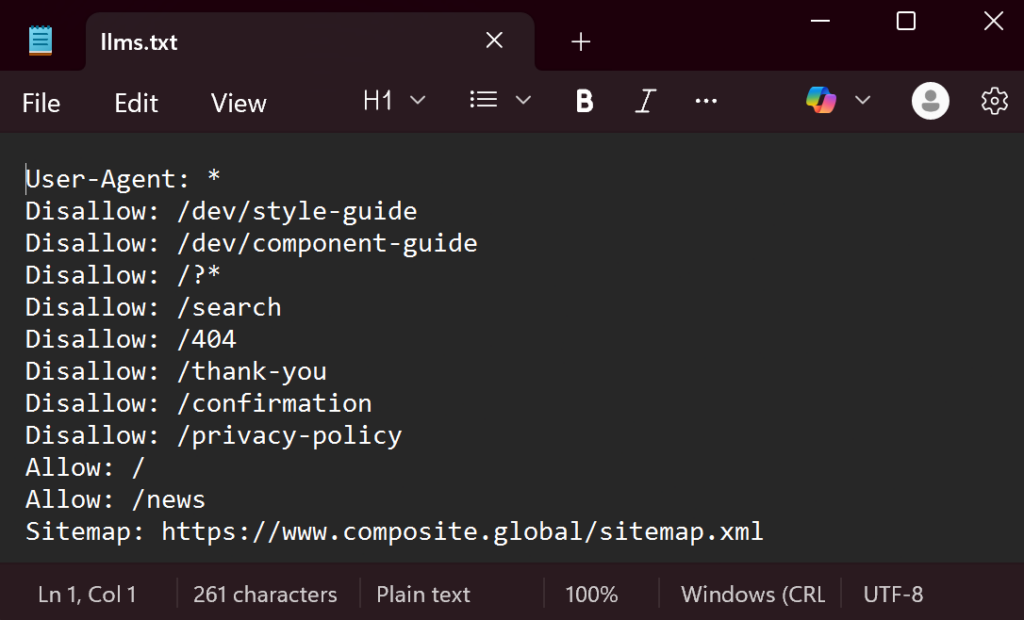
This is where emerging practices like llms.txt come in (an emerging, still-early concept that acts like a robots.txt for AI systems). It’s optional and far from universal, but it shows how businesses are starting to express preferences about how AI should use their content.
By defining:
- what AI tools can learn from
- how they can reference your content
- which areas are off-limits
…you create a clearer boundary around customer data and company information.
A deeper breakdown of this emerging protocol is outlined in SEO for ChatGPT: Help LLMs Understand Your Website.
As AI embeds deeper into marketing and analytics workflows, the companies that declare these boundaries early will earn more trust from users and models alike.
Clarity isn’t just a communication tool—it’s becoming a governance tool.
AI Is Changing What Businesses Consider “Customer Insight”
The companies gaining the most from AI-driven analytics aren’t necessarily those with the most data. They’re the companies with the cleanest data.
AI is forcing a shift in how businesses define customer insight:
Old definition:
“What users clicked on, bought, or interacted with.”
New definition:
“What users meant, expected, and understood.”
This new definition requires:
- websites that communicate intent clearly
- consistent messaging across platforms
- meaningful content hierarchy
- AI-readable structure
- ethical data boundaries
- content that AI can interpret without hallucination
Customer insight becomes less about collecting signals and more about enabling models to interpret those signals accurately.
In that world, messy websites create messy data. Clear websites create clear insights.
AI Understanding Depends on Human Design Choices
AI’s ability to understand customers still depends on a series of very human design decisions. The way a company tells its story, arranges information, and structures its website directly shapes what AI can interpret.
Clarity in language, predictable navigation, and consistent descriptions across platforms all help models identify what matters and how different pieces of content relate.
When the underlying content is organized thoughtfully, AI can read meaning instead of guessing at it. When it’s vague or fragmented, even the most advanced models struggle to interpret intent.
The quality of AI insight is ultimately determined by the quality of the decisions humans make when designing the experience.
The Future: Businesses That Communicate Clearly Will Understand Customers Clearly
AI is not replacing customer research. It’s expanding it, and in many cases, sharpening it.
But the accuracy of AI-driven insights is tied directly to how well your digital presence communicates with machines. A website is no longer just a user-facing asset. It’s a training document for the AI systems your customers increasingly rely on.
Businesses prepared for the next era of customer understanding will be those that treat their website not as decoration, but as structured intelligence.
AI gives companies more insight than ever, but only if companies give AI something clear to interpret. In the end, understanding customers starts with how well you help machines understand you.