
Sign up for our newsletter to get access to exclusive State of Meetings content and insights.
You’ll be rerouted to a special URL after providing your details.
The State of Meetings Report

State of meetings
Professionals emphatically feel that morning is the best time to hold a meeting, with 70% preferring to schedule them between 8am and 12pm. Even for those who prefer afternoon meetings, earlier is still better – with just 12% favouring meetings after 2pm. These attitudes are almost universal across the UK, USA and Germany, with the most divisive time being late morning — this is the preferred time for meetings for 37% of German professionals, compared to 33% of British and 23% of American professionals.
Organisation is key to efficient meetings, but visual stimulus is less important than setting clear goals and agendas.
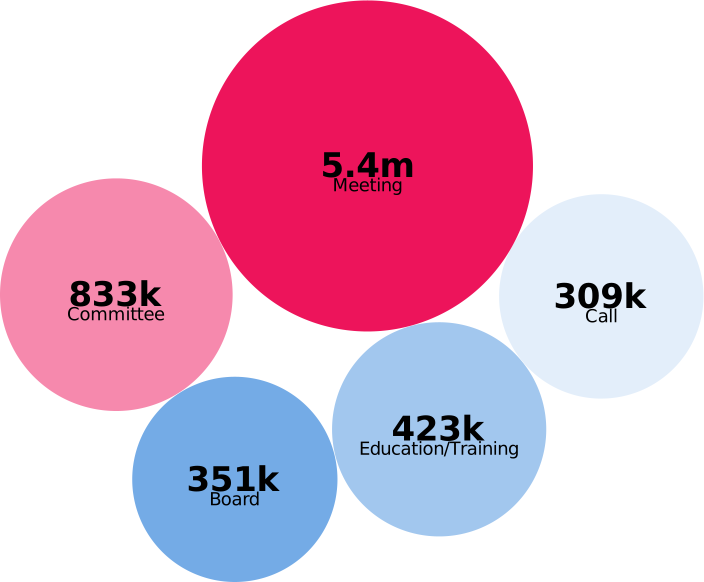
What kind of meetings are we having? We analysed data from over 10m meetings arranged on our platform in 2018 to find out the most commonly used words when arranging meetings with colleagues and clients.
What do we call a meeting?
US/UK – Meeting
Spain/France – Réunion
Germany – Meeting, Sitzung
Switzerland – Meeting, Sitzung, Réunion, Rinunione
Brazil – Réuniao
Italy – Riunione
Which countries are most efficient when it comes to scheduling meetings? We looked at over 19m responses to meeting invites sent out on Doodle in 2018, working out the average time it takes someone from each country to respond to a meeting invite.
Importance of meetings
Meeting face to face is vital, with professionals preferring this method over all other meeting types. Two thirds of professionals from the UK, Germany and USA all feel that face to face meetings make it easier to make important decisions. 100% of respondents also agreed that face to face meetings help them understand other peoples’ opinions and arguments better.
“Although technology has made it easier and easier to meet remotely, and that is a good thing, there is something particularly powerful associated with individuals coming together to meet face-to-face…”
Professor Steven Rogelberg
Chancellor’s Professor
and Professor of Management
at the University of North Carolina
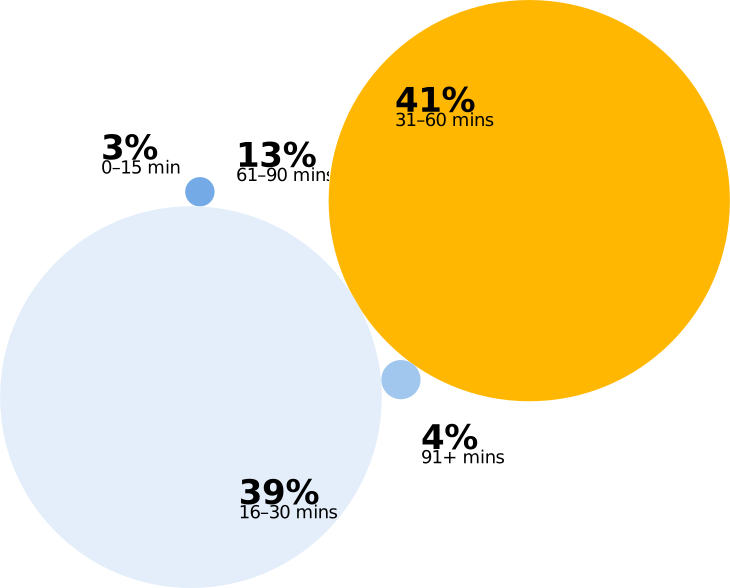
The average meeting lasts around an hour, with 54% of professionals saying their average meeting takes between 30 minutes and 1 hour.
Meeting length shows a strong correlation to an individual’s level of seniority, with those earning over €51,000 per annum twice as likely to have hour long meetings as those earning less than €28,000 per annum.
Those earning higher salaries also tend to be more active participants in meetings, with just 8% of professionals earning more than €51,000 per annum saying they aren’t usually an active participant in work meetings, compared to 18% of those earning less than €28,000 per annum.
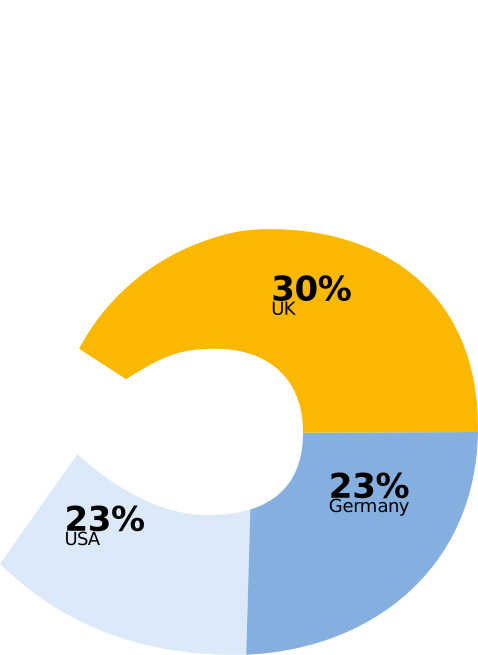
British professionals spend the most time in meetings every week, with nearly a third (30%) of respondents reporting they spend five or more hours in meetings per week. 23% of professionals in the USA spend this time in meetings, while the 23% of German professionals spend 2 and a half hours in meetings every week.
Busy professionals (those attending five or more meetings a week), are also far more likely to actively participate in the discussion — with 70% of busy professionals playing a key role compared to 49% of professionals attending less than five meetings a week.
Our Nielsen research also discovered that 25% of professionals in the USA have more than 15 meetings, catch-ups, calls and internal meetings every week, accounting for 20m working professionals.
Predictably, those spending time in lots of meetings feel improperly attended meetings are the biggest cost to their company, more so than those attending less than five meetings per week.
Interestingly, busy professionals are less fussy about their preferred meeting method. More respondents who attend five or more meetings per week believe that video conferences, conference calls and one on one phone calls can be effective methods of meeting. This likely reflects the fact that they place greater importance on the quality of a meeting’s attendants, rather than the format itself.
“The secret of a successful and time-efficient meeting is preparation. The agenda mustn’t be too long…”
Dr. Sankalp Chaturvedi
Associate Professor
of Organisational Behaviour and Leadership,
Imperial College London Business School
Although technology has made it easier and easier to meet remotely, and that is a good thing, there is something particularly powerful associated with individuals coming together to meet face-to-face. Communication tends to be more rich and nuanced given that verbal and non-verbal cues readily abound. These additional layers not only can promote deeper understandings, but can help actually foster relationships as communication intent is easier to see and empathize with, and misunderstandings are a bit easier to avoid.
Unlike a virtual meeting where it is easier to hide in the background and multi-task, face-to-face meetings tend to have more accountability and engagement. Furthermore, I would contend that individuals’ preference to make important decisions in these face-to-face meetings, perhaps, is more to do with how problematic remotely meetings can be when not run well. Namely, leaders often lack the skill set to truly facilitate a remote meeting effectively. These types of meetings require unique tactics and approaches otherwise genuine and deep discourse does not occur.
Steven Rogelberg
Chancellor’s Professor
and Professor of Management
at the University of North Carolina
The secret of a successful and time-efficient meeting is preparation. The agenda mustn’t be too long. Otherwise there’s a risk of spending too much time on the first items and later items are rushed. The agenda should be circulated well in advance, including the goals of what is expected from the meeting, and specific detail on the subjects and time allocation. Too often attendees do not familiarise themselves with the agenda until they get to the meeting, and that’s where wasted time can kick in – members use time in meetings to think rather than share. This can be avoided by being prepared in advance of the meetings.
Another danger that causes wasted or less productive time is senior executives having too many meetings and are not getting requisite time to think. The resulting risk is that within meetings they then go by their hunches (heuristics), which could be wrong because they haven’t thought the subject through enough. It is when we don’t think sufficiently that mistakes can be made.
Above all else, what is vital is that meetings end with a closure, a set of decisions and the all-important ‘to do’ actions.
Dr. Sankalp Chaturvedi
Associate Professor
of OB & Leadership
at Imperial College London



Personal impact of meetings
Nearly two thirds (71%) of professionals lose time every week due to unnecessary or cancelled meetings. More German professionals (74%) reported regularly losing time to poorly organised meetings than those in the UK (72%) or the USA (68%).
This is likely to be a reflection of the fact that Germans tend to be more involved in meetings they attend, with 65% of Germans saying they play an active role in meetings they attend, compared to just 48% of British professionals and 51% of those in the USA.
Face to face meetings are by far our preferred method of meeting, and the effect of these being poorly organised, ineffective or cancelled outweighs other common annoyances.
“Any collective that masters the art of leading (and participating in) effective meetings will see an array of tangible benefits in completing projects to time and budget, achieving their specific strategic aims, and doing all of this with less human resource – which are all directly related to successful communication…”
Paul Axtell
Author of Meetings Matter
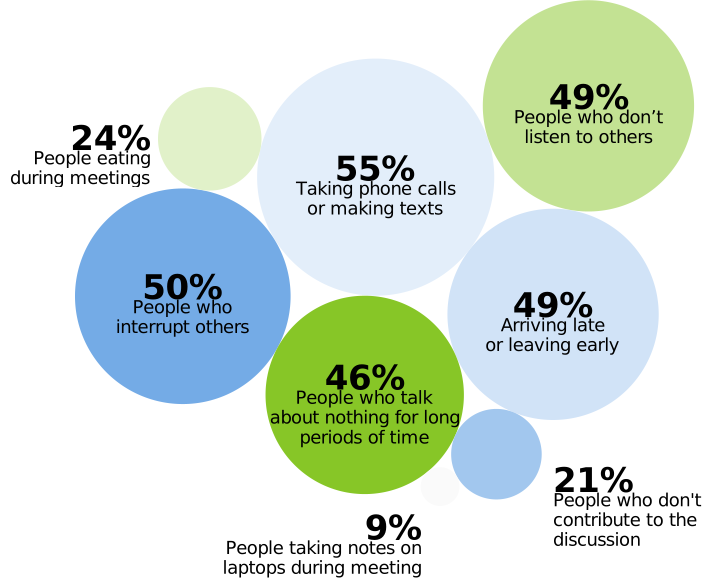
When it comes to ineffective meetings, there are a number of behaviours or actions that professionals reported as irritating them and rendering meetings inefficient.
Any collective that masters the art of leading (and participating in) effective meetings will see an array of tangible benefits in completing projects to time and budget, achieving their specific strategic aims, and doing all of this with less human resource – which are all directly related to successful communication.
On top of that, hitting these benefits can see new products hit the market faster, allow for more collaborative relationships with clients and stakeholders to develop, and will attract better talent, which will all also positively affect bottom lines.
Unfortunately, individual employees are the ones who pay the less-obvious costs associated with poor meetings by not being fully-up-to speed and organised, which can see them take work home, therefore not relaxing and regenerating. In the short term, individuals can push through these issues – but long term they pay a high price through the additional stress.
“The impacts of poor meetings also affect people’s own behaviour. When they feel a meeting isn’t working for them, they end up bringing other work and multi-tasking rather than owning the conversation.
Financial impact of meetings
100% of respondents described poorly organised meetings as a waste of time or money. The effect of these is felt in a number of ways, with over a quarter (26%) of respondents stating that poorly organised meetings impact their client relationships.
Poorly organised or cancelled meetings pose the biggest time drain to businesses in the UK, with 40% of employees believing this is the biggest threat to their company’s time. 38% of Germans see this as the biggest threat, while 34% of Americans believe it’s the biggest threat to their company.
Professionals spend an average of two hours in pointless meetings every week. When viewed at scale, the impact of this is huge, costing the economy billions of dollars every year. While one pointless meeting might not seem of great consequence, these results certainly show that with a little effort to improve meeting scheduling — huge savings in both time and money can be made.
Exchange rates calculated December 2018.
About the report
The Doodle State of Meetings Report 2019 is a comprehensive look at the way meetings are organized in at work. Each chapter looks into various pain points, issues and recommendations around meetings, in order to improve meetings and reduce the wasting of both time and money.
Combining Doodle user data with two separate research reports, the report also includes comment from leading organisational academics and psychologists to create what we hope is an informative, insightful and useful report into the state of meetings.
Data collection
The state of meetings report comprises data from three sources – an in-depth Nielsen study of 1,000 professionals (conducted August 2018), a survey of 5,528 professionals form the UK, Switzerland Germany & the USA (conducted October – December 2018), and analysis of over 19 million meeting responses shared via the Doodle platform in 2018.
Data has been presented in its original form, and only used comparatively where appropriate. The report is designed by Studio Blackburn and developed by Systems Studio.
About Doodle
The world’s leading online scheduling platform, Doodle enables busy professionals to focus on their real work by making time-consuming tasks like scheduling and organizing meetings fast and easy. Used by over 30 million people every month, Doodle offers a solution for each type of meeting and team – like the classic Doodle to for large group meetings and Doodle 1:1 for one-on-ones.
Check it out: www.doodle.com