
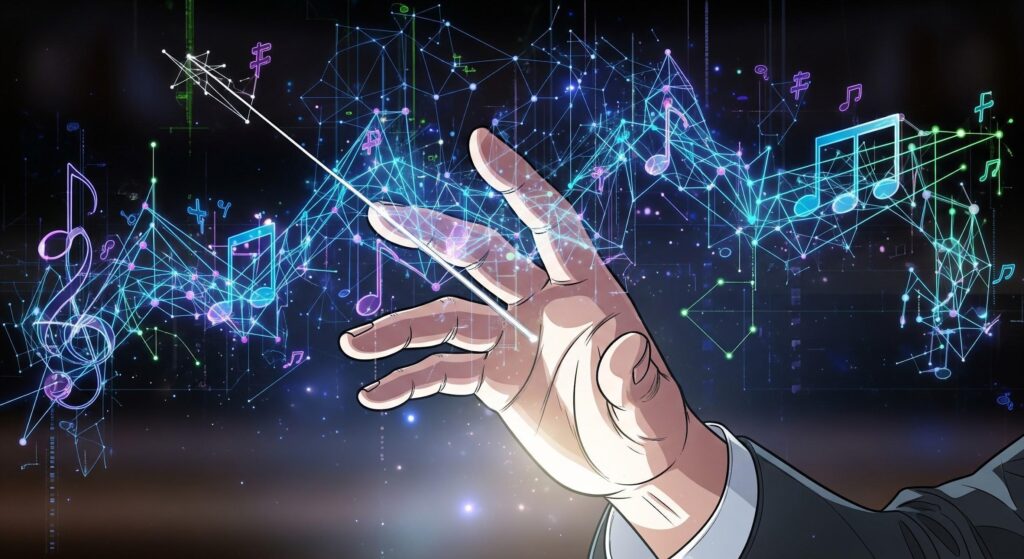
Artificial Intelligence is reshaping nearly every creative field, and music is no exception. We are currently witnessing a fascinating evolution where the meticulous, pattern-recognizing power of algorithms is blending seamlessly with the intuitive, emotional depth of human composition. The core question for contemporary musicians and producers isn’t if AI will replace them, but how it will partner with them to unlock entirely new sonic possibilities. This integration involves training models to compose original music or assist musicians, effectively blending the art of sound with the precision of algorithmic pattern recognition.
The idea of a machine generating music has been a fixture of science fiction for decades, but modern AI systems are moving far beyond simple note randomization. Today’s music generation models are built on sophisticated neural networks, often employing generative adversarial networks (GANs) or transformer architectures. These models don’t just mimic existing styles; they learn the underlying rules of harmony, rhythm, and structure from vast collections of musical pieces. They dissect the fundamental relationships between different musical elements—the way a melody resolves, the interplay of instruments, and the emotional arc of a composition.
The fuel for this creative machinery is data. For these models to achieve genuine compositional depth, they require a comprehensive and well-labeled audio dataset for machine learning, which provides the necessary foundation for learning musical grammars. This data acts as the model’s education, allowing it to move from simple imitation to generating truly unique, context-aware sonic output. This learning process means that the AI can then function as a dynamic compositional partner, capable of filling in gaps, suggesting unexpected chord progressions, or even scoring a film cue to precise emotional specifications.
Beyond full composition, AI is proving invaluable in the granular, time-consuming aspects of music production. Think about the exhaustive process of sound design or creating variations on a theme. AI tools can take a simple musical phrase—a motif—and generate hundreds of structurally and stylistically consistent variations instantly, accelerating the ideation phase dramatically.
These systems serve as powerful scaffolding for human creativity. A composer can sketch out the basic framework of a piece, and the AI can be tasked with providing the orchestration, generating counter-melodies, or even managing the dynamics of a score. This significantly lowers the barrier to entry for complex arrangements. For example, an indie game developer with limited budget and musical expertise can leverage AI to create a rich, adaptive soundtrack that responds dynamically to in-game action, something that previously required a dedicated team of composers and orchestrators.
As AI systems become more autonomous, the debate over authorship—who truly “owns” the music—becomes more pressing. Is the author the human who trained the model, the team who built the underlying algorithm, or the AI itself? Legally and philosophically, this is uncharted territory.
For now, the most compelling applications involve what can be termed “hybrid authorship,” where the human provides the creative vision and selects the AI’s output, thereby retaining artistic control. This collaboration involves:
- Prompting and Curation: The musician defines the stylistic constraints, emotional tone, and instrumentation. The AI generates possibilities, and the human selects, edits, and refines the best material.
- Performance Enhancement: AI can analyze a human performance and suggest micro-edits in timing, pitch, or phrasing, effectively acting as an automated, incredibly discerning mixing and mastering engineer focused purely on artistic intent.
- Style Transfer: AI allows an artist to apply the structural or harmonic rules of one musical style (e.g., Baroque counterpoint) to a completely different sonic palette (e.g., ambient electronica), leading to truly novel genres.
The next frontier in AI music is the ability to generate music with genuine emotional depth, moving beyond mere technical correctness. Current models often excel at structure but can sometimes fall flat on emotional nuance. Addressing this requires training models not just on notes and rhythms, but on the context and reaction to music.
Future training protocols will likely incorporate more sophisticated metadata, linking musical elements to established psychological and emotional responses. This goes beyond simple genre tags and delves into the sonic qualities that evoke feelings like nostalgia, tension, or tranquility. The ultimate goal is to create AI tools that can interpret a human’s emotional brief (e.g., “compose a track for a moment of quiet anticipation”) and deliver a composition that reliably hits that affective target. This deeper understanding will solidify AI’s role not just as a creative tool, but as a true co-creator in the expressive landscape of sound.